Showing posts with label Deception. Show all posts

Sunday, December 03, 2006

Alice In Wonderland


"It seems a shame," the Walrus said,
"To play them such a trick,
After we've brought them out so far,
And made them trot so quick!"
The Carpenter said nothing but
"The butter's spread too thick!"

"I weep for you," the Walrus said:
"I deeply sympathize."
With sobs and tears he sorted out
Those of the largest size,
Holding his pocket-handkerchief
Before his streaming eyes.

"O Oysters," said the Carpenter,
"You've had a pleasant run!
Shall we be trotting home again?'
But answer came there none--
And this was scarcely odd, because
They'd eaten every one.

US Failing In Iraq

Friday, August 04, 2006

Fall of The Roman Empire

The current world wars being played out, are similar to the fall of the Roman Empire, and in some way give us hope that we will be able to establish a world based on peace and mutual cooperation after the Empire has fallen into ashes. The similarities between the old and the new Empires are astonishing. I watched some of the Google video's on the Secret Nazi UFO's, and old footage of the Third Reich. People carrying the Roman battle standards, the architecture, the beliefs, the pagan gods and the occult lodges. In one video it was suggested that Von Braun was also working for the Americans very early on during the war. Apparently the Ultra-Secret German and American projects shared the same scientists, the same plans and the same manufacturing base, while the war was going on... The money earned from the sale of weapons to all sides financed the secret projects.

The ideals of the Nazi Occult Empire were transferred to America after the war (Project Paperclip), and the continuation of occult ideologies were perpetuated in hidden forms throughout all areas of American commerce, government, and financial institutions. It is clear that the global elite behind the destruction of Germany are behind the current destruction of the United States. Today, no one disputes that the burning of the Reichstag in Berlin was carried out by the Nazis in order to seize political power. The government buildings were burned down shortly before the German elections. This is a clear occult symbol, the old was burned, destroyed in fire (Agni) - and the new Phoenix (Hitler's Nazis) were to arise from the ashes.

The German people did not vote Hitler and the Nazi party into power after the burning of the Reichstag. The Nazis did not get the political majority they desired. The Catholic Centre party and the Conservatives joined with Hitler to pass the legislation giving Hitler dictatorial powers (the SPD socialist party was outlawed). Knowing the German people, I doubt that Germany would have become a communist slave society, as happened in Russia. For the Nazis the fire portrayed evidence of a convenient enemy.

At the time of early Rome Augustus defeated Mark Antony (27BC) and reorganised the Roman Republic into the Roman Empire. Some historians argue that Julius Ceasar's appointment as perpetual dictatorship (44BC), was the beginning of the Roman Empire. The fall of the Roman Empire came as the Eastern and Western Empires fought to establish dominance of their own territories. At every corner of the globe Rome had to exercise military power to try to maintain control of its resources. Until then the Empire had existed only because widespread struggles and wars were not breaking out.

At the end of the Roman Empire regions not only began to resent being controlled by the Romans, they rebelled. And the rebellions spread to every corner of the Empire. Local military commanders rebelled, as will happen in the Middle East. The Americans and British maintain a military presence in Iraq today to prevent the Iraqi government aligning itself with Iran. It is the same in Afganistan. The soldiers of the Romans legions did not want to endlessly live in lands far from home, and so the local populations were used to police the various regions by creating Roman soldiers out of the indigenous populations. This meant that local populations eventually had command of Roman armaments, supplies, military styles and strategies. These well equipped armies later turned against their masters as commanders and regional strategists conspired to get rid of the Romans.

Why pay taxes to Rome? The taxes would be paid to local government leaders, to local regional leaders and used for regional military governments. It is the same question in the Middle East. Why be economic slaves to the West? Why should western powers control local and regional resources? Why should they control governments? Who are they to come into another sovereign state and control what goes on there? It's the fall of the Roman Empire all over again, and as the Empire falls it becomes increasingly violent, it attempts to do through military might what it cannot do through mutual agreement.

American and British soldiers will eventually get annoyed at being deployed overseas for longer periods of time. They will want to go home. The clock is ticking, time is running out. When the western military powers finally hand over control to the local forces, the local forces will rebel, they will ask: Why are we being controlled from the West? They will turn around and seek to establish local and regional control of the resources. Exactly as happened during the last days of the Roman Empire.

The barbarians who fought their way to Rome were well trained by the Romans themselves, and they knew how to payback what was due. There was no way the Roman Empire could maintain ongoing control through expensive mililtary campaigns across the Western and Eastern Empires. The regional powers had simply waited, built up their powers and had prepared for the rebellions, that soon spread like wildfire from region to region.

The reason the British foreign office are tearing out their hair, is because they know control cannot be affected through brute force, bombing, killing, genocide... Bush and Blair have done more in the past month to destroy diplomacy than all the Middle Eastern wars combined. Silently, the whole Arab world have decided this cannot continue. The effects of these decisions will be seen across the Middle East over the next two generations as the small children who survive the brutal killings bring up their children and their grandchildren. It is over this time that the greatest changes will occur. The Romans never considered that their brutality would bring its own natural fallout. They simply assumed that they would continue to rule as the most powerful global force. Whereas the most powerful global force is cooperation, not military might. Fall of The Roman Empire

Doris Lessing: On Dreams & The Ending of Empires
BILL MOYERS: But dreams are not rubbish.

DORIS LESSING: They're rubbish if they lead you to very unrealistic actions. That's what's bad about them. If you're dreaming about wonderful Utopias, and great horizons, and great dawns and all that, you're not really seeing what's there, and what could be done.

BILL MOYERS: Well, of course, you spent a lot of time trying to undo the British Empire. And I would say that you were successful. You and history.

DORIS LESSING: You know, when I was a girl, the idea that the British Empire could ever end was absolutely inconceivable. And it just disappeared, like all the other empires. You know, when people talk about the British Empire, they always forget that all the European countries had empires. You know, the French, and the Portuguese, and the Dutch, and you name it, excepting Germans, because they lost theirs. But they all had empires. And that's one of the themes of the BILL MOYERS: The sweetest dream?

Do you ever stop writing?

Monday, July 17, 2006

Caves of Illusion

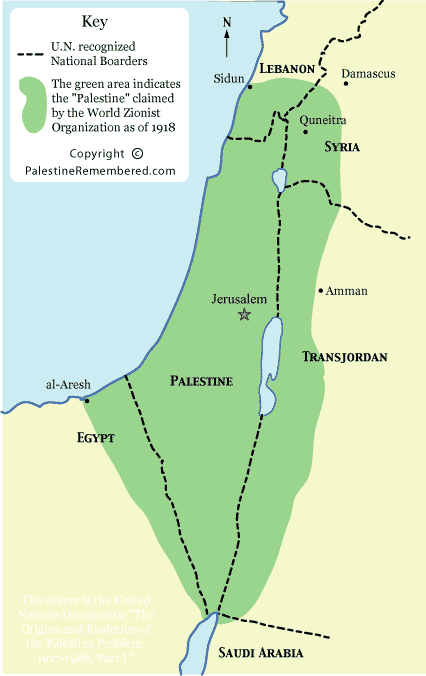
I was reading somewhere that Israel's bombardment of Lebanon aims to force the Lebanese Government to send troops south to guard the border between Lebanon and Israel. Apparently, until the Lebanese Government can act, the bombardment from Israel will continue. Fortunately, the UN decided today to begin the process of deploying UN peacekeepers along the border between Israel and Lebanon - in order to help meet the war demands of Israel. The border would be secure, attacks would be prevented and Israel could stop bombing Lebanese towns, cities, roads, bridges, petrol stations, airports, power stations and civilian vehicles. At the moment it sounds like a valid move to stop the escalation of an already overheated, war... But, strangely no! Israel have made it clear that there will be no deployment of UN forces in the south of Lebanon. Reading this caused me to go do some research. Apart from the fact that Israel most probably have their eye on the waters of the Litani river, I discovered that this present conflict could possibly be part of a cave dweller type plan to fool the International community and secure the borders of a 'greater Israel.' Who Knows?

This is the Map of Greater Israel submitted by the World Zionist Organization soon after the end of WWI. The "Jewish state" was founded on an ancient Biblical map, and Israel still refuse to declare its borders in favor of future expansion.

The Biblical map, extends its borders around the occupied West Bank (including occupied East Jerusalem), occupied Gaza Strip, southern Lebanon, the western parts of Jordan, and southern Syria including the occupied Golan Heights.

Ben-Gurion "had a dream" to annex southern Lebanon to the "Jewish state", and to establish a Christian state north of the Litani River. 'The Muslims rule of Lebanon is artificial and easily undermined. A Christian state ought to be set up whose southern borders would be Litani River. Then we'll form an alliance with it." In the coming years he repeated this idea, and according to Moshe Sharett, Moshe Dayan (who was Israeli's chief of staff in the early 1950s) responded favorably to this idea and who according to Sharett said: "In his [Dayan] view, all we need to do is to find a Christian Lebanese officer, perhaps no higher than a captain, and win him over or buy him with money, so that he would declare himself the savior of Maronite population. Then the Israel army would enter Lebanon, occupy the territory in question and establish a Christian government which would form an alliance with Israel." Sharett himself considered this an "awful" idea.

Ben-Gurion clearly never believed in static borders, but dynamic ones as described in the Bible. He stated during a discussion with his aides: "Before the founding of the state, on the eve of its creation, our main interests was self-defense. To a large extent, the creation of the state was an act of self-defense. Many think that we're still at the same stage. But now the issue at hand is conquest, not self-defense. As for setting the borders - it's an open-ended matter. In the Bible as well as in our history, there all kinds of definitions of the country's borders, so there's no real limit. No border is absolute. If it's a desert - it could just as well be the other side. If it's sea, it could also be across the sea. The world has always been this way. Only the terms have changed. If they should find a way of reaching other stars, well then, perhaps the whole earth will no longer suffice."


Well, maybe I am missing something? But from my own observations of life many of us may want many things; but we cannot always get what we want - especially when it is unrealistic in terms of everyday life. What are they going to do? Wipe out all the people living in Lebanon and Syria? Nuke them? Bomb them? Poison them? Drive them into the sea? Because, it seems the people already living in Lebanon are getting in the way of an unrealistic cave dwellers impression of what one can and cannot do in terms of living with ones neighbours in a country facing future severe water shortages. Nuke the water supply and who can drink the water?

Tuesday, June 28, 2005

Water Wars Loom in Middle East

Although most conflicts between states would appear to be of an ideological nature, the reality is that brutal force is the drive to obtain natural resources and ideology is the leverage tool to justify the attacks. What is it that animals compete over? Territory, areas where food is gathered. Blackbirds are easier to observe in this struggle because they are on the ground searching for their food. In towns and cities food gathering areas for these birds has been reduced to small plots of grass between walls and concrete roads. In those tiny spaces there is only so much to eat. The birds have to keep others off their ground in order to feed, and feed their young. It is no different with humans, only human beings take more than they need.

Throughout the Middle east you have ever increasing populations and a rapidly dwindling supply of water. The small patch of grass is drying up and the birds have to find new feeding areas. These confllicts may be be clothed in the feathered dress of irreconcilable Religious and Ideological divisions, but these ideas are merely to give us the appearance that we humans are of a higher intelligence, using reason to discern rather than basic need. The bright feathers justify the war and are part of the war dance, rational avoidance of our fragile animal dependance on the earth and its scarce resources.

Current row between Ethiopia and Egypt over Nile water may spark military action. by John Bradley

It is common knowledge that oil and territorial issues spark conflict in the Middle East, but there is now growing alarm over the risk that water could be the catalyst for the next war in the region.

Middle East nations record some of the highest birth rates in the world but have only 0.4 per cent of the world’s recoverable water resources. Some 80 per cent of people in the region rely on water that flows into their country from at least one other.

The potential for disputes over this scarce essential resource is obvious, a risk clearly illustrated by a currently escalating row between Ethiopia and Egypt over access to the waters of the River Nile.

Former United Nations secretary-general Boutros Boutros-Ghali said last month that if no solution is found, the disagreement will ’certainly’ spark military confrontation.

Dr Joyce Shira Starr, author of the influential book Covenant Over Middle Eastern Waters: Key To World Survival, has been warning along with Dr Boutros-Ghali for years that the region is on the brink of war over water.

She says that the ’21st-century challenge for the international community is to harness and link technological advances with water-sharing agreements’.

The quote: ’The next war in the Middle East will be over water’ came from Dr Boutros-Ghali. It was that single sentence that launched my own ’mission’ over water,’ she adds.

Ethiopia plans to draw more water from the Blue Nile. Although the river’s source is in Ethiopia, an agreement in 1929 between Britain and Egypt gave Egypt most of the Nile’s water, and Cairo has already made clear that any attempt to alter the waterway’s status will be deemed an act of war.

Another reason for some observers’ growing concern over the potential for war is an alarming report issued this week by Friends of the Earth. The international environmental organisation says that the River Jordan - depleted by huge water diversions by Israel, Jordan and Syria - will dry up within two years.

The potential for ’water wars’ has long loomed large over the Middle East. When former Egyptian president Anwar Sadat signed a peace treaty with Israel in 1979, he said Egypt would never go to war again - except to protect its water resources.

The late King Hussein of Jordan made a similar declaration.

While Dr Boutros-Ghali’s warning of ’certain’ war may seem alarmist, there are precedents.

Israeli Prime Minister Ariel Sharon has said that the Six Days War started because Syrian engineers were working on diverting part of a shared water flow away from Israel. And Israel’s 1982 invasion of Lebanon was planned, in part, as a way of gaining control over Lebanon’s Litani River.

Access to water is also a stumbling block for any permanent settlement of the Israeli-Palestinian conflict.

However, not all experts agree that water wars are inevitable.

Dr Jan Selby, lecturer in the Department of International Relations at the University of Sussex and the author of Water, Power, And Politics In The Middle East, believes that the problem is not allocation of water per se but rather uneven socio-economic development. He cited the Palestinians to illustrate his point that there would be nothing to gain from confrontation.

’Even if the Palestinians were granted their fair share of regional water resources, it is very unlikely that their water problems would go away unless they had the economic and institutional capacity to manage water adequately - to desalinate, treat, conserve and distribute it well,’ he said.

It is in the interest of all parties who need water resources to cooperate, this contrary view concerning the risk of war goes.

Dr Daniel Hillel, author of Rivers Of Eden: The Struggle For Water And The Quest For Peace In The Middle East, adds that a decision to go to war over water would be ’based on a mistaken perception of the problem and a failure of positive vision’.

’So mechanisms are needed to address those issues in a spirit of cooperation and the quest for peace,’ he said.

River Jordan 'nearly running dry'